Market Watch: Six Things to Know This Month.
Market WatchReported1. Market Size Estimates Are Rising, but They Do Not Agree
What happened. Analyst firm GII Research puts the global robot barista market at US$1.86 billion in 2025 and US$2.18 billion in 2026, and forecasts US$4.05 billion by 2030, a growth rate of about 16.8% a year. A different firm, Verified Market Reports, estimates a much broader “robot coffee kiosk” market at US$20.31 billion in 2024 rising to US$51.07 billion by 2032.
Why it matters. The two numbers are not comparable. They count different things and use different methods. Treat any single market figure as a range, and ask what is included before you rely on it.
Sources: industry press coverage of GII Research and Verified Market Reports estimates, August 2026; Global Coffee Report, 2026.
Market WatchOfficial data2. Coffee Is Still Costly, Even as Grocery Inflation Cools
What happened. Statistics Canada reported that coffee prices rose 30.8% in the year to December 2025. By August 2026 overall inflation was 3.0%, and grocery prices rose 2.8% over the year, slower than overall inflation for the first time since July 2024. Gasoline was up 22.8%. We could not find a published coffee-specific figure for 2026 in the sources we checked.
Why it matters. Input costs are easing slowly and remain volatile. Cafés with high labour and ingredient costs gain most from steady, predictable operating models.
Sources: Statistics Canada CPI releases for December 2025 and August 2026, as reported by BlogTO and CP24. Read the source
Market WatchCompany-reported3. Robot Makers Are Going Global, and Fast
What happened. COFE+, a robotic café brand developed by Shanghai Hi-Dolphin Robot Technology, showed its seventh-generation system at a trade fair in China in September 2026. The company says it can prepare more than 300 drinks in eight categories, uses a six-axis robotic arm and prints edible foam designs, and that it is expanding to 75 countries.
Why it matters. Choice for buyers is growing quickly. So is the gap between a company’s claims and what a machine does in a Canadian or American café. This is exactly why an assessment matters.
Source: company press release via GlobeNewswire, September 15, 2026. Crawell has not assessed this machine.
Market WatchReported4. Funding Is Real but Selective
What happened. Artly, a Seattle robot barista company, raised about US$410,000 in an early-2026 crowdfunding round, compared with about US$3.57 million in its 2024 campaign. One analysis describes the two rounds as roughly flat in valuation.
Why it matters. Investors are still funding robot café ideas, but they are looking for proof of deployment and recurring revenue. Owners should ask the same question of any supplier.
Source: KingsCrowd analysis of Artly’s StartEngine offering, 2026.
Market WatchReported5. Consolidation Has Begun
What happened. In January 2026 Miso Robotics bought substantially all the operating assets of Zignyl for stock valued at about US$10 million. In February 2026 Serve Robotics acquired Vebu, developer of the Autocado food-preparation system, for about US$3.7 million.
Why it matters. Smaller food robot makers are being absorbed. Before you commit to a machine, ask how long the maker has funding, who services the machine, and what happens if the company is sold.
Source: KingsCrowd analysis, 2026.
Market WatchReported6. Robots Make Consistent Drinks. People Still Make Connections.
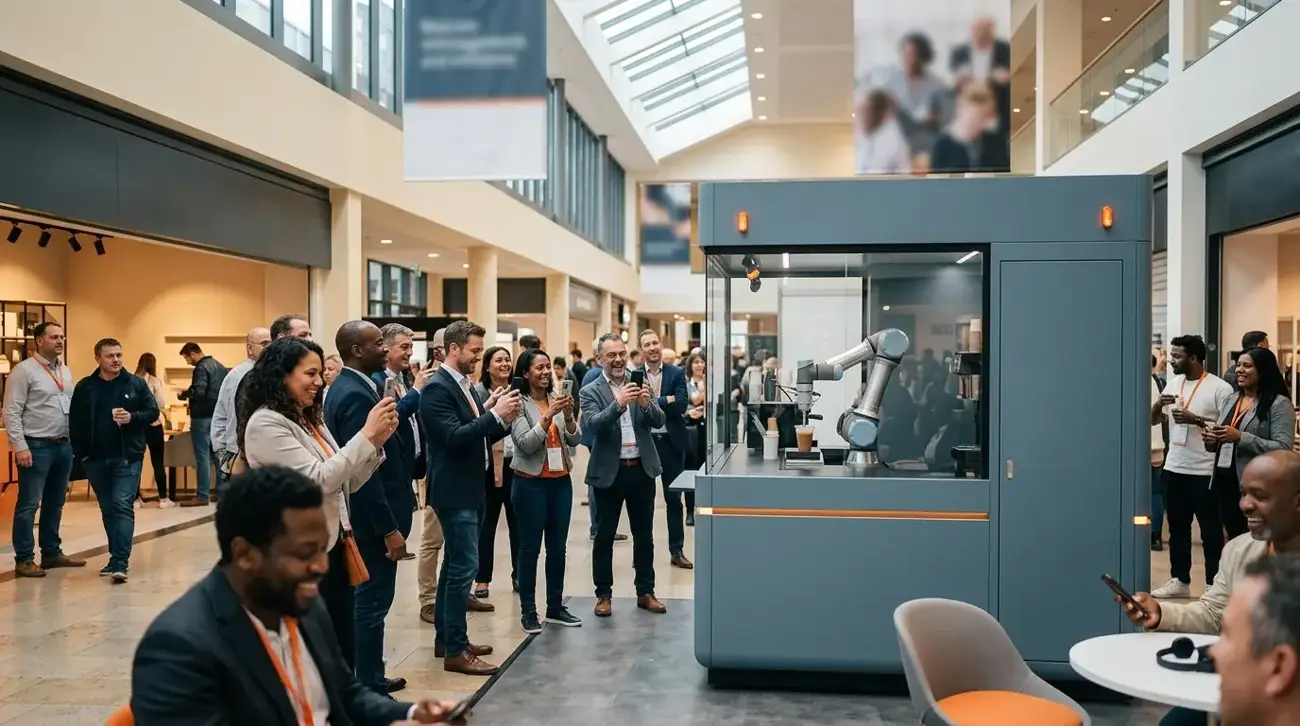
What happened. Coverage of the sector points to demand and curiosity: long queues for robot coffee demonstrations at CES 2026, and a Singapore-made robot that serves about 300 coffees in a single morning shift in cafés and hospitals. Operators also say a robot rarely matches the personal connection of a barista who knows a regular’s name.
Why it matters. This is why Crawell offers Hybrid, with a person at the counter at the hours guests prefer one, alongside fully automated Turnkey. The right mix depends on your site and your guests.
Source: Global Coffee Report, 2026.
What We Are Watching Next
- Whether the first 2026 numbers on coffee prices in Canada and the USA confirm a sustained fall.
- Which robot makers can show real deployments, uptime, and service in North America.
- How food safety and import rules are applied to unattended machines in Canada and the USA.
- More funding rounds, acquisitions, and failures among robot café companies.